
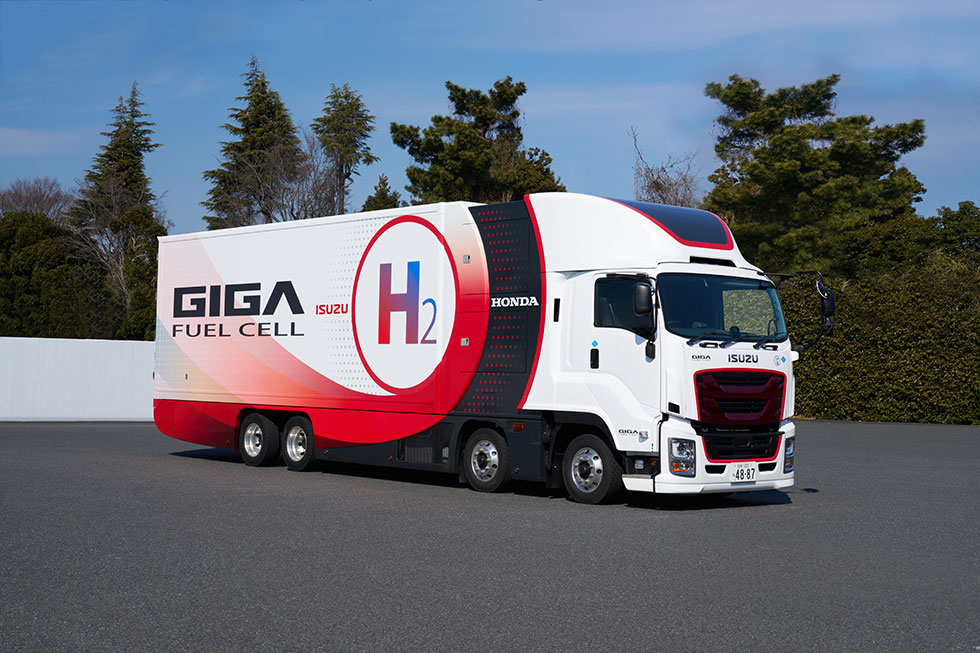
Isuzu Motors Limited and Honda Motor Co., Ltd. today announced that they have signed a partnership agreement based on the decision to have Honda develop and supply the fuel cell system for the fuel cell-powered heavy-duty truck Isuzu is planning to introduce to market in 2027.
The two companies have been working together on the development of hydrogen fuel cell trucks since 2020. In 2022, they jointly developed a fuel cell-powered heavy-duty truck that has been granted a Japanese license plate number for use on public roads.
Isuzu and Honda believe that fuel cell technology, which utilizes hydrogen as fuel resulting in no CO2 emissions, will be effective to achieve carbon neutrality of heavy-duty trucks which are required to address large load capacity, long-time use, long-distance driving and the need for quick refueling.
The two companies are currently planning to start demonstration testing of a prototype truck on public roads before the end of the current fiscal year (ending March 31, 2024). By fully leveraging experience and knowledge gained through the joint research, the two companies will continue making progress in the development of products that fulfill the performance and conditions required for heavy-duty trucks and satisfy customers.
Moving forward, the two companies will take advantage of the respective strengths of each company and accelerate the development of clean, low-noise, low-vibration fuel cell-powered heavy-duty trucks. This will contribute to the shift toward the use of clean energy by the entire industry, including logistics businesses, with more proactive use of hydrogen energy, through which both companies will strive to achieve the shared goal – which is the realization of a carbon neutral society.
Other companies working on hydrogen fuel cell trucks
In addition to Isuzu and Honda, a number of other companies are working on the development of hydrogen fuel cell trucks. These include:
- Daimler Trucks
- Hyundai Motor Company
- Toyota Motor Corporation
- Volvo Group
These companies are all working to develop hydrogen fuel cell trucks that are capable of meeting the needs of the commercial trucking industry. They are developing trucks that have a long range, can be quickly refueled, and are affordable.
The development of hydrogen fuel cell trucks is a major step forward in the fight against climate change. Hydrogen fuel cell trucks produce zero emissions, which helps to reduce air pollution and improve air quality. They are also more efficient than gasoline-powered trucks, which can save money on fuel costs.
Comparison between Hydrogen Fuel Cell and Battery Electric Vehicle
The development of hydrogen fuel cell trucks is still in its early stages, but it is clear that this technology has the potential to revolutionize the commercial trucking industry. As the technology continues to develop, we can expect to see more and more hydrogen fuel cell trucks on the road in the years to come.
The efficiency of hydrogen fuel cell conversion of hydrogen into electricity can vary depending on a number of factors, including the type of fuel cell, the operating conditions, and the purity of the hydrogen. However, typical efficiencies are in the range of 40-60%.
For example, a study by the U.S. Department of Energy found that a proton exchange membrane (PEM) fuel cell had an efficiency of 53% when operating at 75 degrees Celsius and 1 atmosphere of pressure. The study also found that the efficiency of the fuel cell decreased as the temperature decreased.
Another study by the National Renewable Energy Laboratory found that a solid oxide fuel cell had an efficiency of 60% when operating at 800 degrees Celsius and 1 atmosphere of pressure. The study also found that the efficiency of the fuel cell increased as the temperature increased.
The efficiency of hydrogen fuel cells is still improving, and it is expected that efficiencies of 80% or more will be possible in the future. This would make hydrogen fuel cells a more attractive option for transportation and other applications.
Here are some of the factors that can affect the efficiency of hydrogen fuel cell conversion of hydrogen into electricity:
- Type of fuel cell: There are different types of hydrogen fuel cells, and each type has its own efficiency range. PEM fuel cells are the most common type of hydrogen fuel cell, and they have an efficiency range of 40-60%. Solid oxide fuel cells have an efficiency range of 50-80%.
- Operating conditions: The efficiency of hydrogen fuel cells can vary depending on the operating conditions, such as temperature and pressure. Hydrogen fuel cells typically operate at high temperatures and pressures, and the efficiency of the fuel cell decreases as the temperature and pressure decrease.
- Purity of hydrogen: The purity of the hydrogen can also affect the efficiency of hydrogen fuel cells. Hydrogen fuel cells typically require high-purity hydrogen, and the efficiency of the fuel cell decreases as the purity of the hydrogen decreases.
The efficiency of batteries converting potential charge into electricity depends on the type of battery and the operating conditions. However, typical efficiencies are in the range of 50-90%.
For example, a study by the U.S. Department of Energy found that a lithium-ion battery had an efficiency of 90% when operating at 25 degrees Celsius. The study also found that the efficiency of the battery decreased as the temperature decreased.
Another study by the National Renewable Energy Laboratory found that a lead-acid battery had an efficiency of 80% when operating at 25 degrees Celsius. The study also found that the efficiency of the battery decreased as the temperature increased.
The efficiency of batteries is still improving, and it is expected that efficiencies of 95% or more will be possible in the future. This would make batteries a more attractive option for transportation and other applications.
Here are some of the factors that can affect the efficiency of batteries converting potential charge into electricity:
- Type of battery: There are different types of batteries, and each type has its own efficiency range. Lithium-ion batteries are the most efficient type of battery, and they have an efficiency range of 80-90%. Lead-acid batteries are less efficient, and they have an efficiency range of 60-80%.
- Operating conditions: The efficiency of batteries can vary depending on the operating conditions, such as temperature and discharge rate. Batteries typically operate at room temperature, and the efficiency of the battery decreases as the temperature decreases. Batteries also have a maximum discharge rate, and the efficiency of the battery decreases as the discharge rate increases.
- Age: Batteries lose efficiency over time, and the efficiency of the battery decreases as the battery ages.
 Elektronikar