
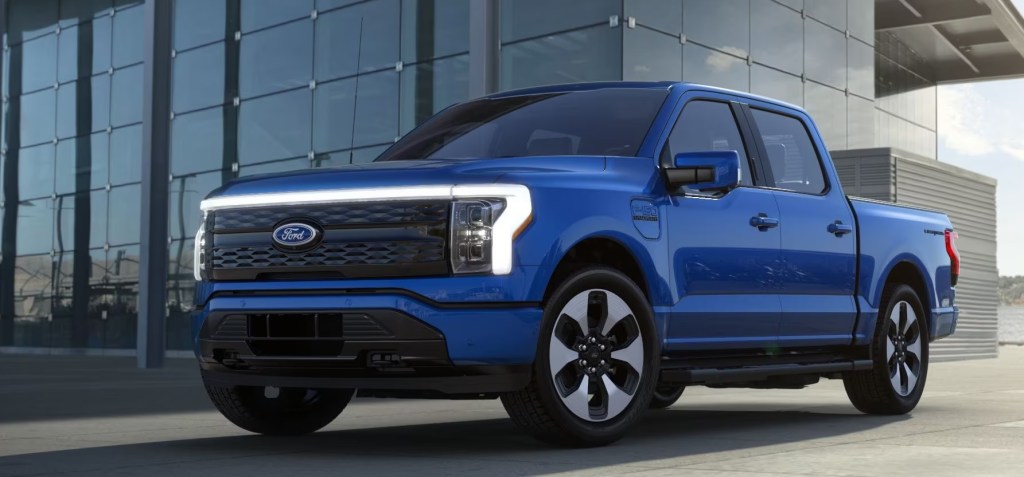
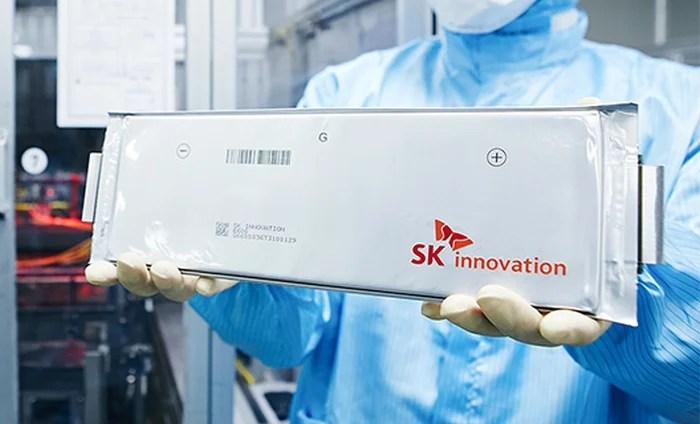
- SK Innovation’s reluctance to share its battery technology and manufacturing process is delaying the production of Ford’s F-150 Lightning electric truck.
- The Korean company is concerned that sharing its technology could lead to Ford starting its own cell manufacturing.
- The internal bickering between Ford and SK highlights the challenges faced by automakers in securing a reliable and cost-effective supply of batteries for their electric vehicles.
Ford’s highly anticipated F-150 Lightning electric truck is facing production delays due to industrial espionage concerns with its battery supplier, SK Innovation.
The Korean company is reluctant to provide full access to its cell technology and manufacturing process, which has led to concerns for Ford as they investigate a recent battery fire incident before resuming production.
In an effort to resolve the issue, Ford has sent its own team of battery researchers to meet with SK Innovation in Korea and plans to send equipment installation engineers from its Blue Oval SK joint venture in the US in the coming weeks.
However, SK Innovation is wary that providing deeper access to its battery technology could lead to Ford starting its own cell manufacturing, and they are not alone.
The Korean government has designated EV battery-making technology and high-nickel cathode materials as national security trade secrets, leading to hesitation from SK Innovation and other Korean battery giants to share their technology and manufacturing processes with foreign companies.
To work around these issues, Ford is exploring alternative partnerships with local battery makers and has recently announced a partnership with the world’s largest battery maker, CATL, which avoids federal subsidy restrictions on Chinese tech and allows for whole ownership of the factory.
The internal dispute between Ford and SK Innovation underscores the difficulties automakers face in securing reliable and cost-effective supplies of batteries for their electric vehicles as the industry shifts towards electrification, and the demand for batteries increases.
As competition among battery suppliers intensifies, automakers must establish long-term partnerships to ensure a steady supply of batteries for their electric vehicles.
Intellectual property (IP) is a significant concern in the battery business, particularly in the electric vehicle (EV) industry. Battery technology is critical to the performance, range, and cost of EVs, and as a result, companies invest heavily in research and development to create their own proprietary battery designs and manufacturing processes.
Protecting this IP is crucial for maintaining a competitive edge and staying ahead in the industry.
The risk of IP theft is particularly high in the battery industry due to the complex and proprietary nature of the technology involved.
Companies are often hesitant to share their battery designs and manufacturing processes with potential partners or suppliers for fear of intellectual property theft or infringement. This can make it challenging for automakers to secure a reliable and cost-effective supply of batteries for their EVs.
One example of a serious breach of IP in the EV battery industry involves the Chinese EV maker, Xpeng.
In June 2021, the United States International Trade Commission (ITC) issued a limited exclusion order against Xpeng, prohibiting the importation of certain electric vehicles and components into the US. The order followed a complaint by the US-based EV battery maker, LG Chem, which accused Xpeng of misappropriating trade secrets related to its lithium-ion battery technology.
LG Chem claimed that Xpeng had poached employees from LG Chem’s US subsidiary, who then shared confidential information about LG Chem’s technology with Xpeng.
The ITC ruled in favor of LG Chem, finding that Xpeng had infringed on four LG Chem patents related to the manufacturing and use of lithium-ion batteries.
The ruling was seen as a significant victory for LG Chem, which has invested heavily in developing its battery technology and has been seeking to protect its IP. It also highlighted the risks of IP theft and misappropriation in the EV battery industry, which is highly competitive and rapidly evolving.
In the case of Ford’s F-150 Lightning electric truck, the delay in production due to the dispute with SK Innovation highlights the importance of IP protection in the battery business.
The battery supplier is reluctant to provide Ford with full access to its cell technology and manufacturing process, leading to concerns about potential IP theft or infringement.
This has forced Ford to dispatch its own team of battery researchers to meet with SK Innovation and explore alternative partnerships with local battery makers.
Overall, the battery business is highly competitive, and protecting intellectual property is critical to maintaining a competitive edge and ensuring a reliable supply of batteries for the growing electric vehicle market.
According to a 2020 report by the World Intellectual Property Organization (WIPO), the top five countries in terms of the number of patent applications related to electric vehicle (EV) batteries are:
- China
- United States
- Japan
- South Korea
- Germany
It’s worth noting that these rankings may change over time as new patents are filed and granted. Additionally, the number of patent applications doesn’t necessarily equate to the quality or impact of the technology being patented.
 Elektronikar