

Porsche engineers are working on new concepts for brake force distribution to improve recuperation in battery electric vehicles (BEVs) without compromising on comfort.
Basically it starts with coasting and only goes into regen braking when the brake pads are touched by the driver.
The company says, increased weight of batteries in BEVs often requires a more powerful hydraulic wheel brake, but this reduces efficiency and range.
Porsche’s Taycan gets around this problem by using what most electric cars use, recuperation, where the electric motors switch to generation mode as soon as the driver presses the brake pedal.
This brakes the vehicle and generates electricity to charge the battery. In the Taycan, 90% of all braking in everyday situations is done using electric power only, without the involvement of the hydraulic system.
The Taycan Turbo S can generate up to 290 kW of electric power during braking, increasing the range by up to 30%.
However, blending the regenerative and hydraulic braking systems is a major technical challenge for Porsche engineers, as the systems operate differently and the transition between them must be smooth for the driver.
Porsche has developed new algorithms for its Taycan electric vehicle (EV) to improve the smoothness of the transition between traditional and regenerative braking.
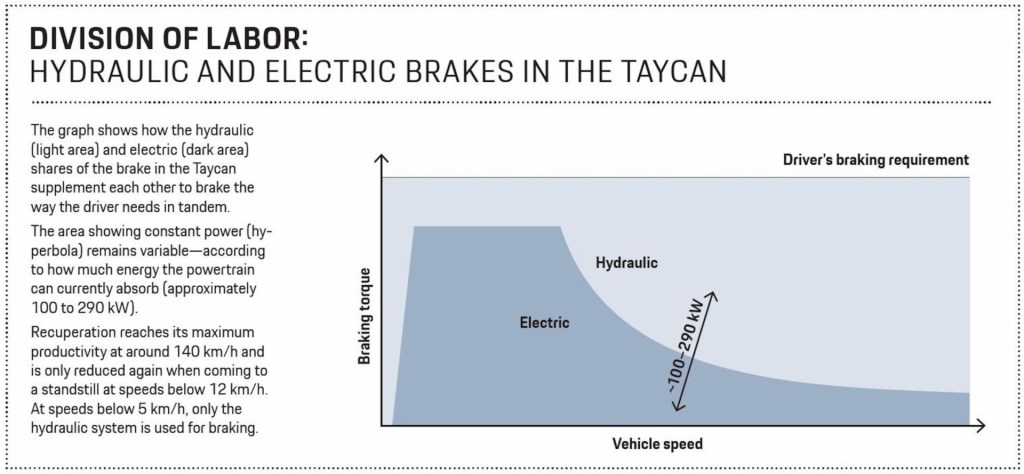
The algorithms monitor the hydraulic system continuously to determine the current ratio of brake pedal travel to brake pedal force, which allows the EV to estimate how much power the hydraulic system will deliver the next time the vehicle is braked and deploy it precisely to ensure a smooth transition to recuperation mode.
Porsche also varies the distribution of braking force between the front and rear axles to maximize energy recuperation. This allows the EV to recuperate up to 30% more energy, increasing the vehicle’s range.
To ensure a smooth transition between the two systems, Porsche has developed a “corridor for distribution” algorithm that analyzes the driving situation and suggests the optimal distribution of braking force between the front and rear axles based on test bench data.
A second algorithm then selects a distribution that suits the current driving situation from the most efficient corridor, which guarantees ideal deceleration and results in a “significant gain in range”.
Porsche is also taking a different approach to driving in EVs compared to some other manufacturers, who are focusing on “one-pedal driving”. This is where the vehicle starts recuperating energy as soon as the driver takes their foot off the pedal, and in some cases, the vehicle brakes so hard that the brake lights come on.
Porsche is instead using a method called “coasting” which is a more natural process of allowing the vehicle to continue to roll unpowered, and recuperation only starts when the brake pedal is stepped on. This is a more efficient way of driving as it keeps the kinetic energy in the vehicle, and reduces losses.
 Elektronikar