

Space is always an alluring prospect, it is exciting, sexy and imminently attention grabbing and companies are always willing to be associated to any space-related endeavours.
Honda is no exception and they have entered into an agreement with the Japan Aerospace Exploration Agency (JAXA) to collaborate on the research and development of a “circulative renewable energy system” to power lunar rovers and sustain living spaces on the moon.
The system, which combines Honda’s high-pressure water electrolysis technology with a fuel cell system, aims to generate oxygen, hydrogen, and electricity using solar energy and water.
Under the contract, Honda will conduct concept studies and develop a “breadboard model” prototype by the end of the 2023 fiscal year in Japan.
This marks a significant advancement in Honda’s efforts, following a joint research agreement with JAXA in November 2020 to explore the potential of the circulative renewable energy system for lunar surface use.
The collaboration between Honda and JAXA is aimed to find new solutions for sustainable energy on the moon, which will be a crucial step for long-term human presence on the lunar surface.
The Artemis Program, a U.S.-led international space exploration initiative in which Japan also plays a role, aims to conduct long-term human exploration of the lunar surface in the latter half of the 2020s.
To support this endeavor, a reliable and sustainable source of electricity is essential. This is necessary not only for the operation of lunar roving vehicles but also for enabling human habitation in these vehicles.
One of the challenges of supplying electricity on the moon is the 14-day cycle of light and darkness on the lunar surface, particularly in areas with the least amount of sunlight.
Solar power generation can supply electricity during the day, but a different means of power generation is needed for the 14-day night period. One option would be to transport large numbers of secondary batteries from Earth to the Moon, but this would be cost-prohibitive.
This is where Honda’s circulative renewable energy system comes in. The system, which generates oxygen, hydrogen, and electricity using solar energy and water, is more compact and lightweight than traditional secondary batteries.
This makes it a viable solution for supplying electricity on the lunar surface, particularly during the 14-day night period.
The Honda circulative renewable energy system was selected for its ability to generate electricity in a sustainable and cost-effective manner, which is crucial for long-term human presence on the lunar surface.
Honda’s circulative renewable energy system, which combines its high differential pressure water electrolysis system and a fuel cell system, is designed to continuously produce oxygen, hydrogen and electricity from solar energy and water.
When used on the lunar surface, the system utilizes electricity generated from solar power during the day to electrolyze water and produce oxygen and hydrogen, which is then stored in tanks. During the night, the fuel cell system uses the stored oxygen and hydrogen to generate electricity and supply it to the living space.
One of the key advantages of Honda’s high differential pressure water electrolysis system is its compact design, as it does not require a compressor, which is typically needed to compress hydrogen.
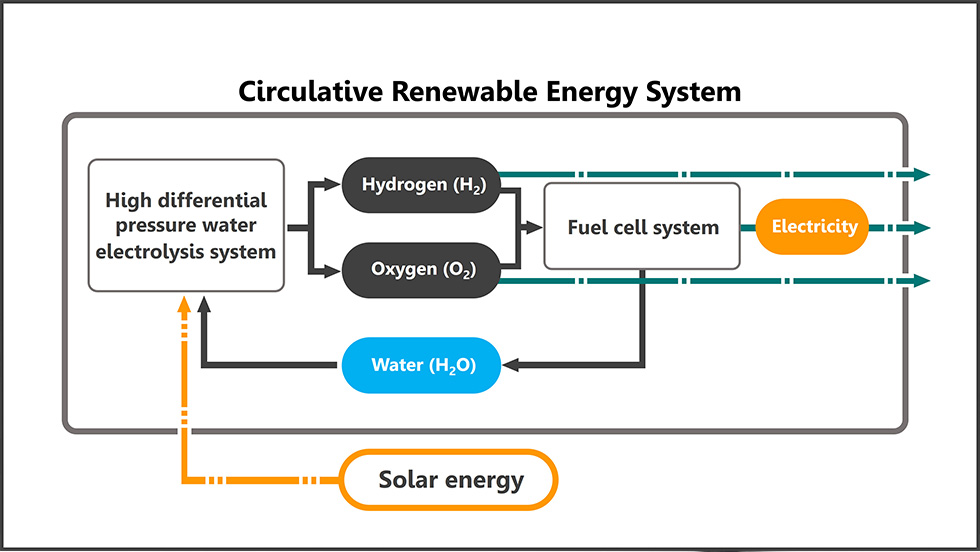
Additionally, the circulative renewable energy system has a higher gravimetric energy density than a secondary battery, allowing it to store the same amount of energy with a smaller mass.
This feature contributes to the reduction of payload capacity and mass, which is a major challenge in space transportation.
Honda has been researching and developing hydrogen technologies for many years and has been a pioneer in the field.
In 2002, it became the first company in the world to start lease sales of fuel cell vehicles. Additionally, Honda has been developing and installing smart hydrogen stations using its high differential pressure water electrolysis systems.
With JAXA, Honda will continue to build on its hydrogen technologies to realize the circulative renewable energy system for lunar exploration.
Honda’s circulative renewable energy system is not only capable of generating electricity, but it can also produce oxygen and hydrogen using solar energy and water.
The oxygen generated by the system can be used to support human life at lunar outposts, while the hydrogen can be used as fuel for transfer spacecraft that will land and take off from the Moon.
This technology has applications on Earth as well. The circulative renewable energy system can serve as a carbon-neutral energy supply system, generating electricity from solar energy and abundant water resources on Earth.
Honda plans to conduct research and development on its circulative renewable energy system with the goal of utilizing it in outer space, but also feeding the technologies back to Earth to support the company’s goal of achieving carbon neutrality by 2050.
 Elektronikar