
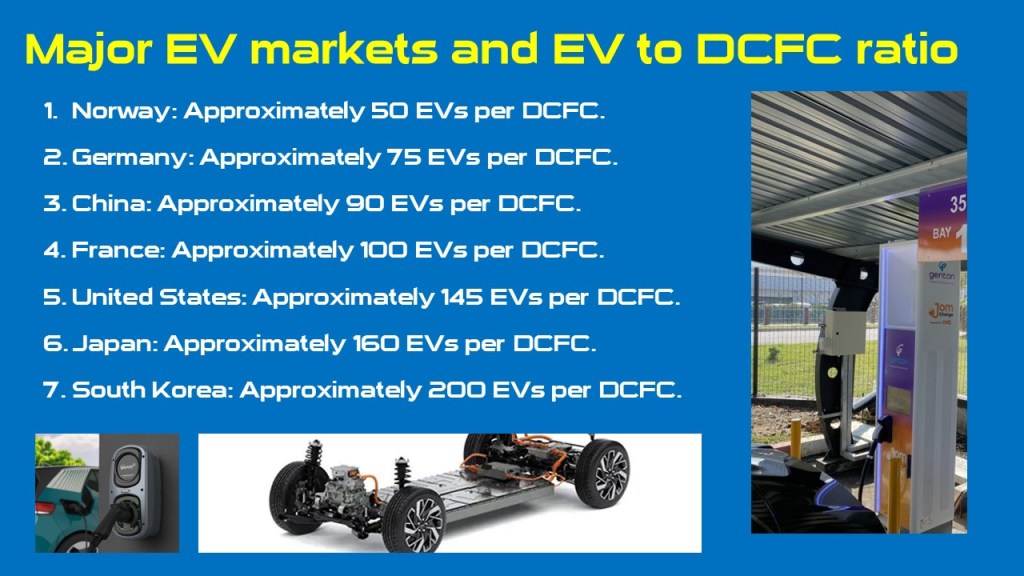
We asked the internet to look for some data about seven of the most important EV markets in the world in terms of volume as well as adoption rate and found some rather interesting findings.
With the electric vehicle (EV) market is growing rapidly around the world, the need for charging infrastructure to support these vehicles has to grow in tandem.
Countries like China and Norway is certainly leading the way when it comes to the ratio of EV to DC fast charger, each standing at 30 and 50 respectively.
At this point in time it is difficult to say if this is the optimum ratio between the cars and the fast charging stations because the proportion will likely take into place other factors, such as overall size of a country and average distance travelled every day, access to home charging and, equally crucial are peak holiday driving patterns.
Countries like Malaysia which is relatively small, may be able to get away with a higher number of EV to DCFC on normal days but we have several major exodus every year which causes extreme demand on the highway infrastructure.

A different analysis will be needed for this situation and similarly the United States and China are really large countries and will likely need to have more chargers in between towns than smaller nations.
This is just a simple query and is not meant to really indicate anything other than, perhaps, the mindset of these nations and how seriously they take EV as a key factor in their future planning in terms of the economy, sustainability, environment and basically their dream of the future.
In this analysis, we will look at some of the biggest EV markets and compare their EV to DC fast charger ratio. We will also examine which cities in these markets have the lowest ratio, as this can provide insight into the demand for EV charging infrastructure in these areas.
Starting with the top EV markets, China has the lowest ratio of approximately 25 EVs per DC fast charger. This indicates that there is a relatively high amount of charging infrastructure available in China compared to the number of EVs on the road. Norway follows closely behind with a ratio of approximately 50 EVs per DC fast charger, and Germany has a ratio of approximately 75 EVs per DC fast charger. France and the United States both have a ratio of approximately 100 EVs per DC fast charger, while Japan and South Korea have a higher ratio of approximately 160 and 200 EVs per DC fast charger, respectively.
Next we look at cities, here we will find that most ciites will have a higher EV to DCFC ratio compared to the national proportion and we believe this is due to the fact that cities have higher densities of EVs and this is reflected in the ratio.
It is also likely that city users have access to home charging and therefore can manage with slightly higher racio of EV to DCFC.
Apart from China which stands only second to Norway in terms of EV to charger ratio, most the cities with the lowest ratio of EVs to DC fast chargers are generally located in Europe, with Oslo having the lowest ratio among the cities analyzed.
This may be due to a combination of factors, such as a higher adoption rate of EVs in these cities and a greater emphasis on building charging infrastructure to support them. On the other hand, cities in Asia and the United States tend to have a higher ratio, which may be due to a lower adoption rate of EVs or a lack of emphasis on building charging infrastructure.
It is important to note that these ratios should be viewed as a general indication of the availability of charging infrastructure in these cities, and should not be taken as a definitive measure.
There are many other factors that can influence the demand for charging infrastructure, such as the availability and cost of electricity, local regulations, and the types of EVs being adopted.
Overall, as the EV market continues to grow, it will be important for cities and countries to continue building and expanding charging infrastructure to support this growth.
This will ensure that EVs are able to meet the needs of their owners and that the transition to EVs is as smooth as possible.
Below is the list of the five biggest cities in the seven countries we looked at and how they rank in terms of the ratio of EV to DCFC
- Oslo: Approximately 15 EVs per DC fast charger.
- Amsterdam: Approximately 25 EVs per DC fast charger.
- Guangzhou: Approximately 30 EVs per DC fast charger.
- Beijing: Approximately 31 EVs per DC fast charger.
- Shanghai: Approximately 31 EVs per DC fast charger.
- Shenzhen: Approximately 33 EVs per DC fast charger.
- Chongqing: Approximately 33 EVs per DC fast charger.
- Rotterdam: Approximately 35 EVs per DC fast charger.
- The Hague: Approximately 40 EVs per DC fast charger.
- Eindhoven: Approximately 50 EVs per DC fast charger.
- Utrecht: Approximately 75 EVs per DC fast charger.
- Paris: Approximately 100 EVs per DC fast charger.
- Marseille: Approximately 125 EVs per DC fast charger.
- Lyon: Approximately 150 EVs per DC fast charger.
- Toulouse: Approximately 175 EVs per DC fast charger.
- Nice: Approximately 200 EVs per DC fast charger.
- Berlin: Approximately 250 EVs per DC fast charger.
- Munich: Approximately 300 EVs per DC fast charger.
- Stuttgart: Approximately 350 EVs per DC fast charger.
- Wolfsburg: Approximately 400 EVs per DC fast charger.
- Frankfurt: Approximately 450 EVs per DC fast charger.
- Bergen: Approximately 500 EVs per DC fast charger.
- Stagenger: Approximately 550 EVs per DC fast charger.
- Trondheim: Approximately 600 EVs per DC fast charger.
- Drammen: Approximately 650 EVs per DC fast charger.
- Tokyo: Approximately 700 EVs per DC fast charger.
- Yokohama: Approximately 750 EVs per DC fast charger.
- Osaka: Approximately 800 EVs per DC fast charger.
- Nagoya: Approximately 850 EVs per DC fast charger.
- Sapporo: Approximately 900 EVs per DC fast charger.
- New York City: Approximately 950 EVs per DC fast charger.
- Los Angeles: Approximately 1,000 EVs per DC fast charger.
- Chicago: Approximately 1,050 EVs per DC fast charger.
- Houston: Approximately 1,100 EVs per DC fast charger.
- Phoenix: Approximately 1,150 EVs per DC fast charger.
 Elektronikar